Jumat, 10 Juni 2016

SEMANTICS SUMMARY


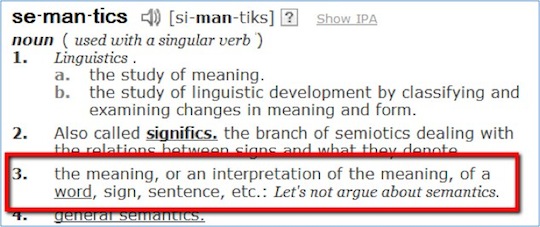
semantics of course is the study of the meaning. that is a simple definition about semantics.

The word semantic (from French sémantique) was invented byMichel Bréal during the 19th century.
- According to Richmond H. Thomason " semantics is the study of the meaning of linguistics expression. The language can be natural language, such as English or Navajo, or a artificial language like a computer programming language ".
- According to The Evolution of language (2010) by W. Tecumseh Fitch " semantics is the branch of language study that consistently rubs shoulder with philosophy. this is because the study of meaning rises a host of deep problems that are the traditional stomping grounds for philosophers ".
- According to Hockett (1945) " language is a complex system from habits and the system has 5 subsystem namely Grammatical, Phonology, Morph-phonemic (morfo-fonemik), Phonetic and Semantic.
- According to Ferdinand de Saussure "  linguistics without semantics is nothing ".

this pictures will give a simple explanation about semantics.


semantics of course has roles. this is the roles of semantics


Seven Types of Meaning

Geoffrey Leech in his ‘Semantic- A Study of meaning’ (1974) breaks down meaning into seven types or ingredients giving primacy to conceptual meaning. The Seven types of meaning according to Leech are as follows.

1) Conceptual or Denotative Meaning:
Conceptual meaning is also called logical or cognitive meaning. It is the basic propositional meaning which corresponds to the primary dictionary definition. Such a meaning is stylistically neutral and objective as opposed to other kinds of associative meanings. The aim of conceptual meaning is to provide an appropriate semantic representation to a sentence or statement. A sentence is made of abstract symbols. Conceptual meaning helps us to distinguish one meaning from the meaning of other sentences. Thus, conceptual meaning is an essential part of language. A language essentially depends on conceptual meaning for communication. The conceptual meaning is the base for all the other types of meaning.

2) Connotative Meaning:
Connotative meaning is the communicative value of an expression over and above its purely conceptual content. It is something that goes beyond mere referent of a word and hints at its attributes in the real world. The boundary between conceptual and connotative seems to be analogous. Connotative meaning is regarded as incidental, comparatively unstable, in determinant, open ended, variable according to age, culture and individual, whereas conceptual meaning is not like that . It can be codified in terms of limited symbols.

3) Social Meaning:
The meaning conveyed by the piece of language about the social context of its use is called the social meaning. The decoding of a text is dependent on our knowledge of stylistics and other variations of language. We recognize some words or pronunciation as being dialectical i.e. as telling us something about the regional or social origin of the speaker. Social meaning is related to the situation in which an utterance is used.

4) Affective or Emotive Meaning:
For some linguists it refers to emotive association or effects of words evoked in the reader, listener. It is what is conveyed about the personal feelings or attitude towards the listener. E.g. ‘home’ for a sailor/soldier or expatriate and ‘mother’ for a motherless child, a married woman (esp. in Indian context) will have special effective, emotive quality. In affective meaning, language is used to express personal feelings or attitude to the listener or to the subject matter of his discourse.

5) Reflected Meaning:
Reflected meaning and collocative meaning involve interconnection
At the lexical level of language, Reflected meaning arises when a word has more than one conceptual meaning or multiple conceptual meaning. reflected meaning has great importance in the study of semantics.

6) Collocative Meaning:
Collocative meaning is the meaning which a word acquires in the company of certain words. Words collocate or co-occur with certain words only e.g. Big business not large or great.Collocative meaning refers to associations of a word because of its usual or habitual co-occurrence with certain types of words. ‘Pretty’ and‘handsome’ indicate ‘good looking’. However, they slightly differ from each other because of collocation or co-occurrence. The word ‘pretty’ collocates with –girls, woman, village, gardens, flowers, etcCollocative meanings need to be invoked only when other categories of meaning don’t apply. Generalizations can be made in case of other meanings while collocative meaning is simply on idiosyncratic property of individual words. Collocative meaning has its importance and it is a marginal kind of category.

7) Thematic Meaning:
It refers to what is communicated by the way in which a speaker or a writer organizes the message in terms of ordering focus and emphasis .Thus active is different from passive though its conceptual meaning is the same. Various parts of the sentence also can be used as subject, object or complement to show prominence. It is done through focus, theme (topic) or emotive emphasis. Thematic meaning helps us to understand the message and its implications properly.

in simple definition of the 7 types :

1. Conceptual Meaning = Logical, cognitive or connotative content.
2. Connotative Meaning = What is communicated by virtue of what language refers
3. Social Meaning = What is communicated of the social circumstances of Language
4. Affective Meaning = What is communicated of the feelings and attitudes of the Speaker through language.
5. Reflected Meaning = What is communicated through associations with another Sense of the same world.
6. Collocative Meaning = What is communicated through associations with words which co-occur with another word.
7. Thematic Meaning = What is communicated by the way in which the message is organized in terms of order and emphasis.

this pictures will give u more explanation about semantics.


Rabu, 01 Juni 2016

kenapa memilih semantic?

kenapa pilih semantik untuk jadi bahan pembelajaran di linguistik? emang ntar ilmunya bisa diterapin kemana aja? asiknya apa sih? emang manfaatnya apa?

pertanyaan seperti ini adalah pertanyaan yang kalau dijawab satu yang lain bakalan ikut terjawab.
kenapa saya memilih semantik? saya suka banget bermain sama makna dan suka menganalis kata. kalau bahasa anak sekarang suka kepo. tapi ini kepo yang bermanfaat. saya suka mencoba mengerti banyak persepsi. awalnya karena saya suka baca novel. kadang, kalau kita tidak cuma baca aja gampang, tapi harus ngerti perasaan penulis, harus ngerti apa yang coba disampaikan dari setiap chapternya. setiap orang pasti punya persepsi yang berbeda beda. misalnya, ada cowo yang baik banget tipenya. emang ini cowo baik banget ke cewe atau ke cowo. tapi, karena tipenya ini, para cewe suka beradu persepsi. ada yang bilang cowo itu PHp,PLAYBOY,MODUS dan lain-lain. padahal, emang ini cowo baik banget. kalau kita tidak bisa mengartikannya dengan serius, pasti akan banyak argumen negatif yang kita ciptain dipikiran kita untuk cowo baik tadi.

semantik bisa diterapin dibanyak bidang kehidupan. misalnya bidang kedokteran, untuk membaca hasil check itu perlu bantuan ilmu semantik. saya ambil contohnya lagi, misalnya dalam ilmu perpustakaan, Penerapan hubungan semantik dalam ranah ilmu perpustakaan digunakan pada kegiatan pengolahan bahan perpustakaan. Hubungan semantik berkaitan erat dengan analisis subjek dan penentuan istilah dalam pengindeksan sebagai titik akses yang bermanfaat pada proses temu-balik informasi. Oleh karena itu, hubungan dua kata atau istilah ini selanjutnya diuraikan lebih lanjut dalam berbagai bentuk kategori hubungan . dan banyak lagi contohnya.

jadi, belajar semantik ini asik banget. kita akan dilatih untuk beradu argumen dengan banyak argumen orang lain dan argumen kita sendiri. ilmunya juga tidak akan sia-sia. percaya deh. ohya, semoga nanti saya dan kalian bisa menerapkan ilmu ini disalah satu bidang yang ingin kita kuasai ya. GBU

Selasa, 17 Mei 2016

semantics

Halo guys, for this section i will try to explain about SEMANTICS. what it is???
okay, semantics of course is the study of the meaning. that is a simple definition about semantics. But, i will try to explain more than definition. check it out...

Definition of Semantics

- According to Richmond H. Thomason " semantics is the study of the meaning of linguistics expression. The language can be natural language, such as English or Navajo, or a artificial language like a computer programming language ".
- According to The Evolution of language (2010) by W. Tecumseh Fitch " semantics is the branch of language study that consistently rubs shoulder with philosophy. this is because the study of meaning rises a host of deep problems that are the traditional stomping grounds for philosophers ".
- According to Hockett (1945) " language is a complex system from habits and the system has 5 subsystem namely Grammatical, Phonology, Morph-phonemic (morfo-fonemik), Phonetic and Semantic.
- According to Ferdinand de Saussure "  lingustics without semantics is nothing ".

According to Hockett's statement about 5 subsystem that their ( refers to 5 subsystem ) position is different . Grammatical, Phonology and Morph-Phonemic is central and Phonetics also Semantics is periferal. Why semantics is periferal? karena makna yang menjadi objek semantics adalah sangat tidak jelas ( according to Linguistik Umum by Abdul Chaer (page 285) ).

so, where is semantics? semantics and the object (meaning) there are around phonology, morphology and syntax.

Type of Meaning

>  Lexical, Grammatical and Contextual

- Lexical is makna yang dimiliki atau ada pada leksem meski tanpa konteks apapun ( makna sebenarnya sesuai hasil observasi indera kita. Seperti kuda, makna leksikalnya adalah binatang kaki empat yang biasa dikendarai. 
- Grammatical is makna karena proses gramatikal. Misalnya, mem dengan tambahan dasar baca. maknanya adalag kegiatan membaca buku.
- Contextual is  makna sebuah kata dalam satu konteks bisa juga tergantung situasinya ( tempat, waktu dan lingkungan ).

> Connotation and Denotation

> Conceptual and Associative

Relasi Makna

- Synonym and Antonym
- Polisemi adalah kata dengan makna lebih dari satu.
- Homonimi adalah kata yang kebetulan sama tapi beda makna.
- Ambigu adalah kata dengan makna ganda karena tafsiran yang berbeda.

Semantics and Syntax

Syntax and semantics both work at sentence level. Syntax has to do with the form and order of words within the sentence. Semantics has to do with the meaning. Syntax is language dependent, whereas the semantics remains the same if the same sentence were expressed in another language.


Selasa, 03 Mei 2016

Lexicology


Lexicology is basically understood as the study of lexis (vocabulary or stock of words of a language). Stock evokes the idea of a set of words which brings the idea of the lexicon. The vocabulary is understood as meaningful units
Lexicology is closely linked to morphology. In lexicology what matters is the meaningful side of the words. And in morphology what matters is the form of these units. The form and the meaning of a word may be related so they are closely linked. Meaning takes us to semantics. Part of the semantic studies is based in meaning: lexical semantics. So lexicology has links to many other areas, but our vision of lexicology is restricted. Etymology is a branch of linguistics on its own. It's regarded with words and its history.
We should never mix lexicography with lexicology because it's not a branch of linguistics but a technique and has a very narrow aim. Lexicography deals with the making of dictionaries. So it's not a level of languages. We have a narrow concept of lexicology: it's a branch of linguistics concerned with the meaning and use of words. There is a diversity of approaches which goes from narrow conceptions to very wide conceptions.
In sentence semantics we can predict the meaning of the whole sentence because we have rules that show it to us. The limit is in lexical semantics, because here we don't have any possible combination that allows us to guess the meaning of a word. So “in linguistics is simply axiomatic that words have meanings.
·         SENSE AND REFERENCE
When we deal with the sense we deal with relationships within language. When we talk about reference we deal with the relationship between language and the world. By means of reference a speaker is pointing at something in the world by using language / a linguistic expression. Therefore with reference there is always an external reality that is being talked about.
It would wrong to think that every linguistic sign corresponds to some external reality. One single linguistic expression may point to different entities of the outside world.
Ex: Your left hand
There are different entities in the outside world that refer to this same expression.

This is called variable reference. The perception of variable reference depends on a number of factors, which are there because of the relationship between language and the world. There are factors like time and place that play and important role in this.
Ex: The British Prime Minister
Does this expression have a referent? Yes. You could say Tony Blair but you could also say Margaret Thatcher. In this expression the time factor isn't expressed so both possibilities are possible. The question of place is specified so you can't say Aznar because it has to be British. If you say the current British Prime Minister, there is no variable reference.
In this relationship between languages and the world we also have expressions which only refer to one entity in the outside world:
Ex: The moon, the sun
They are not so frequent and they don't raise any semantic problems at all and they are not interesting for the purposes of lexical semantics. We can also find a number of linguistic expressions referring to one referent in the outside world:

Ex: The Morning Star
Venus
The Evening Star
In English, there are two expressions that refer to the same entity. This example is always like that, but there are cases in which this association between single entities in the world and different linguistic expressions can be also be made for specific cases.
The British Prime Minister
Tony Blair
The Leader of the Labour Party
This relationship isn't permanent. It has been made for a specific purpose.
That these expressions may be true depends on time and time factors.
Ex: John
The man at the corner
In a specific case these two expressions may have the same referent in the world.
Whenever you talk about reference there is always something in the outside world pointed out by an expression. When we talk about sense what we find is that the sense of a word is its place in a net of semantic relationships within a language. Sense is a purely inherently linguistic phenomenon. Sense is very difficult to define, but very easily perceived by native speakers. The clearest for a native speaker is `sameness of sense'.
Ex:
Almost has the same sense as nearly. These two words occupy the same place in the net of relationships in a language. The same happens with vertical and upright.
John took off his jacket
John took his jacket off
They have different syntactic structures but they have the same sense.
Bachelors prefer red haired girls.
Girls with red hair are preferred by unmarried men.
They also have the same sense.
The opposite also happens, that is, we may have two different senses and one linguistic expression. This is the case of polysemous words.
Ex:
Bank (of money)
Bank
Bank (of a river)
One single sentence can also have more than one sense. These sentences are represented in two different trees depending on the sense.
Ex:
The chicken is a living animal and is going to eat.
The chicken is ready to eat.
The chicken has become a meal and is ready for us to be eaten.
It's a lexical question.
If `with a smile' is a constituent of the higher level, the one who smiles is `He'
He greeted the girl with a smile.
If `with a smile' is a constituent of the lower level, the one who smiles is `the girl'
It's a syntactic question.
Sense is an abstraction, therefore, if you say a linguistic expression has a meaning, it's because it has sense but it may not necessarily have reference because not all words connect with an entity in the outside world. And this is a rule.
Ex:
So, in, at, over, either, onwards, and, almost: these words have no reference in the outside world.
Mind / Thought
Language World


Selasa, 26 April 2016

syntax is....

Hallo...
dear my readers...
i'd like to explain you about syntax in linguistics. what it is?

syntax is study about grammar of a particular language and also about theories of a grammar. At the level of syntax, it is important to understand the distinction between grammaticality and semantic soundness. Sentences such as Me Tarzan, you Jane clearly make sense even though they sound "wrong". Conversely, the sentence Colorless green ideas sleep furiously, famously created by Noam Chomsky, doesn't sound 'wrong' in the way the last sentence did, but it is hard to imagine anything which it would describe. We can say that these two aspects of acceptability vary independently: grammaticality, or well-formedness, gives the rules for how sentences must be constructed, but does not restrict their content, while semantic acceptibility may occur even in ill-formed sentences. When we say that something may occur grammatically, we mean that well-formedness is preserved, with complete disregard for semantics.

Pengertian Syntax

Kumpulan aturan yang mendefinisikan suatu bentuk bahasa.  
- Syntax mendefinisikan bagaimana suatu kalimat dibentuk sebagai barisan/urutan dari pemilihan suatu kata dasar. 
- Kata dikonstruksikan dengan karakter-karakter alfabet. 
   contoh keyword (reserve word) dalam bahasa C : while, do, if, else, dll. 
- Syntax mengatur cara mengkombinasikan kata-kata tersebut ke dalam suatu statement dengan bentuk yang benar sehingga dapat disusun suatu program yang dapat berjalan dengan benar. 
- Syntax tidak mengerti arti atau isi dari suatu kalimat, semantic yang bisa mengartikannya. 
- Syntax menyediakan bentuk-bentuk notasi untuk kominikasi antara programmer dan pemroses bahasa pemrograman, sehingga mempermudah pembuatan suatu program. 
- Syntax dari bahasa pemrograman didefinisikan dengan dua kumpulan aturan, yaitu aturanlexical dan aturan syntactic. 
- Aturan leksikal menspesifikasikan kumpulan karakter yang terdapat dalam alfabet dari bahasa dan cara supaya karakter-karakter tersebut dikombinasikan ke dalam kata-kata yang valid dan dapat diterima. 
- Contoh adalah bahasa Pascal yang tidak memperhatikan huruf besar dan huruf kecil, sedangkan bahasa C dan Ada memperhatikan dan membedakan hal tersebut.

Kriteria Syntax
1) Readability : Mudah dibaca.
2) Writeability : Mudah ditulis.
3) Verifiability : Verifikasi program (konsep kebenaran).
4) Kemudahan Translasi : Penerjemah yang cepat & menghasilkan kode yang efisien.
5) Pengurangan Ambiguitas :  Dua arti atau lebih, contoh Array (pemanggilan fungsi)

 Fungsi Syntax
Sintaks berfungsi menyediakan bentuk-bentuk notasi untuk komunikasi antarprogrammer dan pemroses bahasa pemrograman sehingga dapat mempermudah pembuatan suatu program.

Selasa, 19 April 2016

MORPHOLOGY

Morphology is the branch of linguistics (and one of the major components of grammar) that studies word structures, especially in terms of morphemes. Adjective: morphological.

Morpho is forms and Logos is knowledge or science, so MORPHOLOGY ( MORPHOLOGIE from Yunani ) is the study about forms (ilmu tentang bentuk). In morphology we will learn about morphemes, Morphemes is last part of words ( satuan terkecil dari kata ). this is the explanation about morphemes :
1. Sebuah wacana dapat dipecah menjadi kalimat
2. Kalimat dapat dipecah menjadi bagian makna terkecil, yaitu kata
3. Kata dapat terdiri atas beberapa morfem, contohnya menanamkan = me-tanam-kan, bisa juga hanya terdiri atas satu morfem, misalnya rumah, kursi, selamat, eksekusi
This simple way to analyze morphology:

In adjectives

Smaller            2 morphs small/er
Smallest           2 morphs small/est
Better              1 morph better

In verbs

Worked           2 morphs work/ed
Wrote              1 morph wrote
Written            1. Morph written
Working          2 morph work/ing
Put                   1 morph put

In Gerund

Sittings            3 morph sit/ing/s

In Pronouns

We                   1 morph we
Him                 1 morph him
Its                    2 morph it/s

RELATIONSHIP BETWEEN LANGUAGE and MORPHOLOGIE

  • understanding morphology, we will be easy to make a good words
  • we can combining with other words if we have a good knowledge about morphology
  • we can make a good part of speech and language related with words
  • morphology is a basic all words in language

Process of morphemes :

1. Affixation or Afaksi or Afiks is the process to add imbuhan
2. Reduplication is repeat basic of forms in all part or half of part
3. Composition is Komposisi adalah hasil dan proses penggabungan morfem dasar dengan morfem       dasar, baik yang bebas maupun yang terikat sehingga terbentuk sebuah konstruksi yang memiliki identitas leksikal yang berbeda, atau yang baru.
Proses pembentukan kata dari dua morfem bermakna leksikal.
Contoh :     lalu + lintas     =  lalu lintas
                   rumah  + sakit =  rumah sakit
                   sapu + tangan  =  sapu tangan
4.  Conversion , Modification and Suplesi
     conversion is the way to make a word from other word without change segmental element
     modification is add the others element in one word or one element
     suplesi is make a new form
5.  Pemendekan adalah pembentukan singkatan

i think that's all, thanks
GBU